Resetting the EU Integration process must begin with meaningful reforms
Of the 130 recommendations made in the previous Book of Recommendations, only eight have been fully fulfilled, while 61 have not been fulfilled at all. The new Book of Recommendations highlights key challenges in Serbia’s EU integration process and the need to restore institutional dialogue and trust.
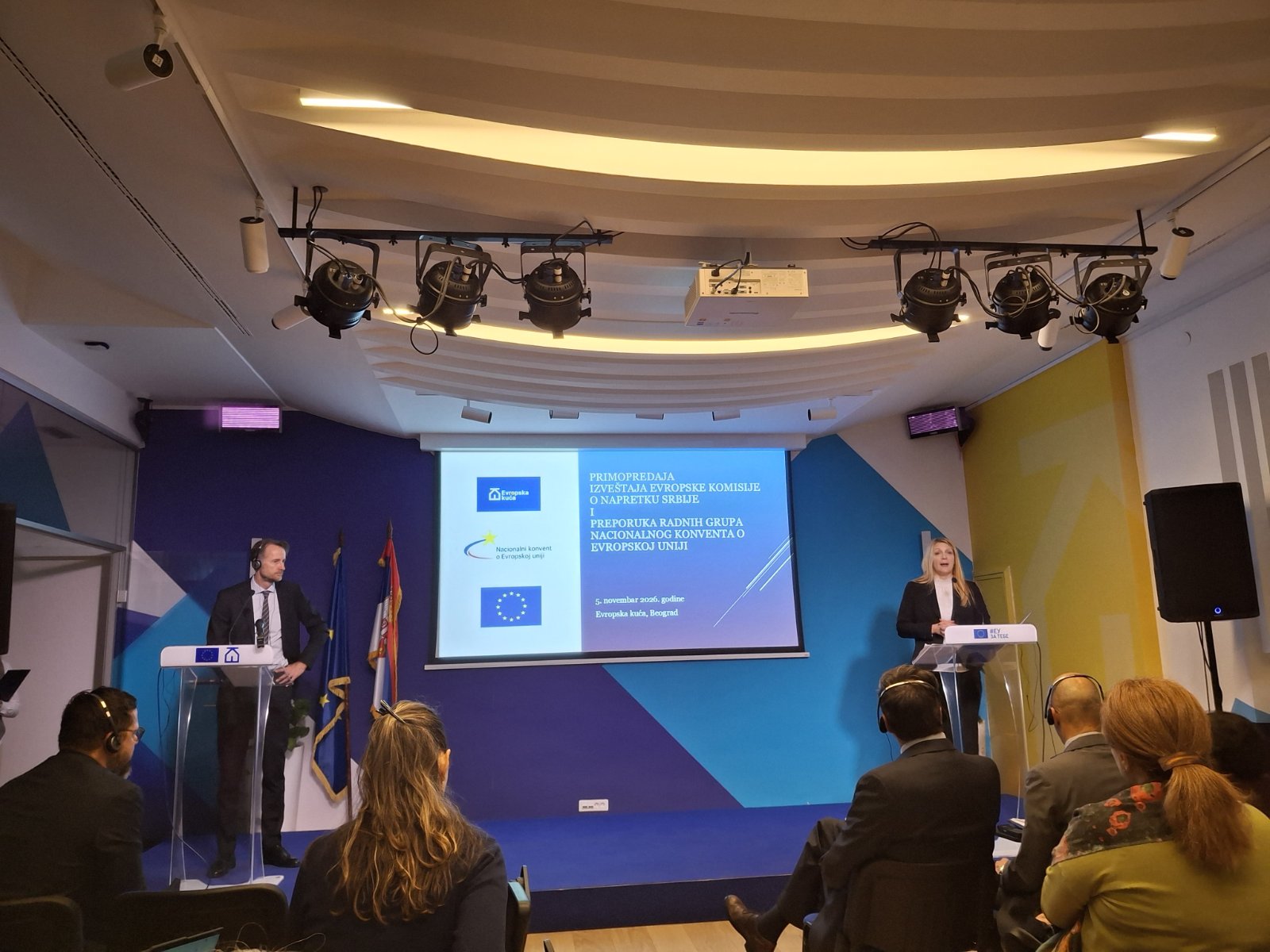
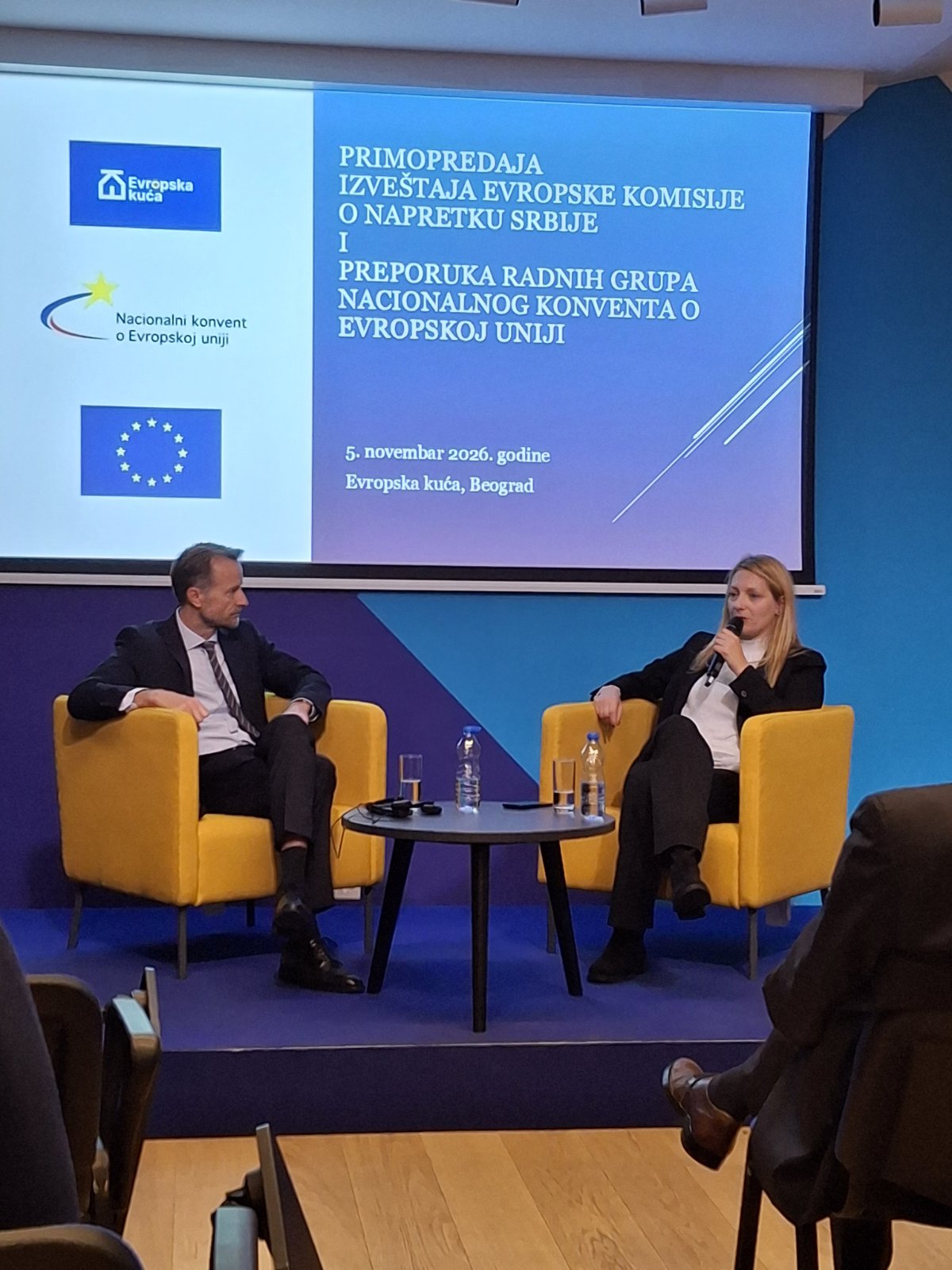
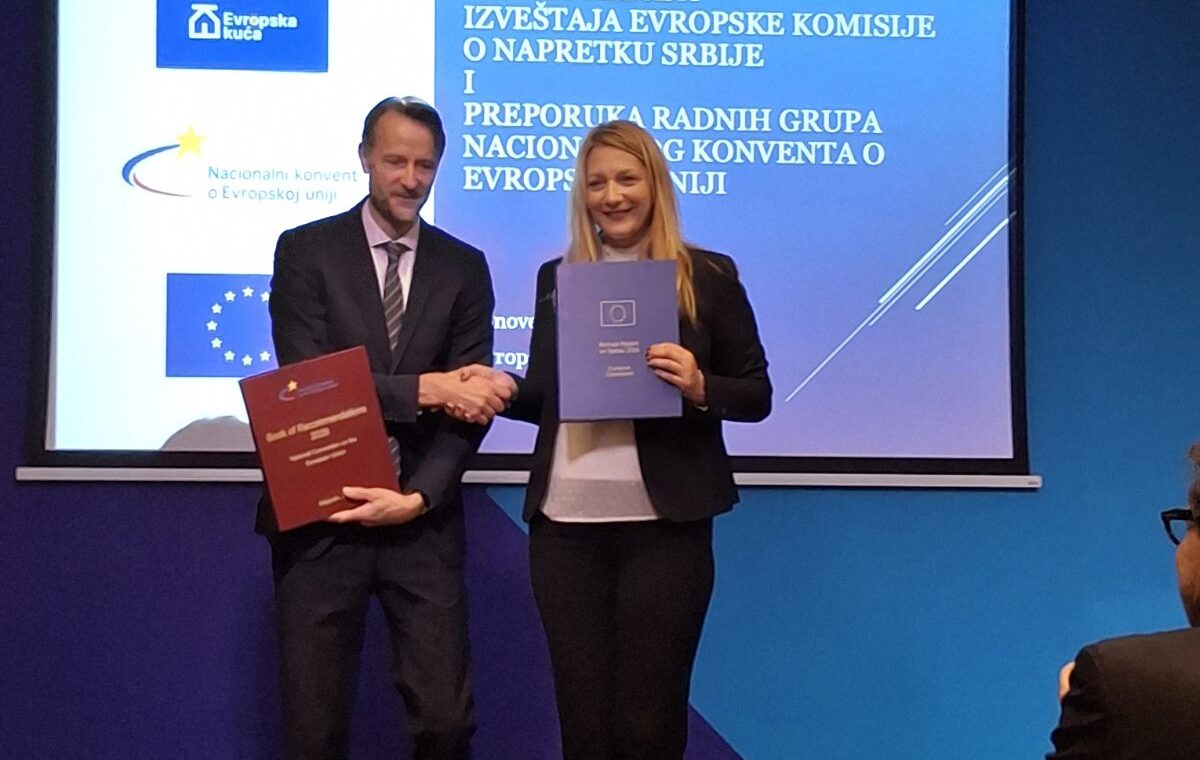
On 5 November 2026, Bojana Selaković, Coordinator of the National Convention on the European Union (NCEU), and H.E. Andreas von Beckerath, Ambassador and Head of Delegation of the European Union to the Republic of Serbia, exchanged the NCEU’s 2026 Book of Recommendations and the European Commission’s 2026 Serbia Report at Europe House in Belgrade.
This year’s Book of Recommendations comes at a time of significant political and social change in Serbia. Following two years of civic mobilisation, protests and blockades, the early parliamentary elections held on 25 October have opened up the possibility of a new phase in the country’s political and institutional development. This moment also provides an opportunity to reassess the course of EU integration to date and establish a different relationship between Serbia, the European Union and civil society.
The National Convention believes that resetting the EU integration process must not mean starting from scratch. The commitments Serbia has undertaken remain in force, while the knowledge and experience accumulated throughout the accession negotiations provide an important foundation for the continuation of reforms. What is essential now is that these reforms are implemented in substance, accompanied by stronger institutions, accountability for decisions taken and transparent dialogue with all relevant stakeholders.
The scale of the task is illustrated by the assessment of the implementation of recommendations issued in the previous year. The NCEU’s working groups assessed the status of 130 recommendations. Eight have been fully fulfilled, 61 have been partially fulfilled, while the same number have not been fulfilled at all. Some recommendations have been repeated for eight or even ten years, pointing to the prolonged failure of institutions to address the problems identified by the Convention.
“Partially fulfilled” is the most frequent assessment in this year’s review. It reflects a recurring pattern in which legislation is adopted without consistent implementation, strategies are developed without adequate resources and institutional capacity to deliver them, and public consultations are held without providing meaningful opportunities for stakeholder participation. EU integration cannot be reduced to adopting legislation and completing administrative requirements. Its purpose must be to change the way institutions work and how they treat citizens, delivering tangible improvements in people’s everyday lives.
A separate section of this year’s Book examines the implementation of the Reform Agenda and the commitments linked to the EUR 1.586 billion available under the Reform and Growth Facility. According to the draft Second Independent Monitoring Report, 15 of the 47 reform steps whose deadlines had expired by June 2026 had been achieved. Of the ten steps due in June, only one had been achieved, while the European Commission had yet to assess three payment requests with a combined value of EUR 625 million. These figures further underline the need for systematic monitoring of commitments and clear accountability for their implementation.
The European Commission’s 2026 Serbia Report finds that Serbia has made no substantive progress in the accession negotiations. Although Cluster 3 is technically ready to be opened, further progress in the accession process depends on results in fundamental areas, above all the rule of law, the functioning of democratic institutions and the normalisation of relations with Kosovo. The Commission specifically points to the lack of progress in the areas of the judiciary and fundamental rights, as well as further backsliding in freedom of expression and the media.
The National Convention emphasises that civil society participation in the EU integration process is not a privilege that institutions may grant or withdraw. It is a European democratic standard. In the recent period, the work of the Convention and its member organisations has taken place amid increased pressure and campaigns targeting organisations and individuals monitoring the EU integration process. Despite these circumstances, the Convention’s working groups have continued to monitor reforms, prepare analyses and issue recommendations. Restoring regular, transparent and institutionalised dialogue between the state and civil society is one of the prerequisites for a credible continuation of Serbia’s EU integration process.
The National Convention remains ready to offer its expertise, experience, well-founded criticism and cooperation to the incoming authorities in implementing reforms. Its role remains unchanged, regardless of changes in government: to monitor the EU integration process, identify departures from commitments undertaken and insist on institutional accountability. The Convention expects its recommendations and the expertise brought together through its work to inform the development of future reform policies.
Brussels is convinced by change, not by reports.
The NCEU Book of Recommendations for 2026 is available at: https://eukonvent.org/wp-content/uploads/2026/11/Book-of-Recommendations-2026.pdf