
Second Trilateral Meeting on the Reform Agenda — civil society raises substantive concerns
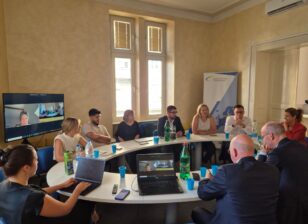
On 13 May 2026, the Government of the Republic of Serbia, the European Commission and the National Convention on the European Union (NCEU) held the Second Trilateral Meeting on the implementation of Serbia’s Reform Agenda under the Reform and Growth Facility (RGF). The meeting was hosted by the EU Delegation to Serbia and brought together line ministries, DG NEAR and EU Delegation officials, and coordinators of the NCEU’s Intersectoral Working Group (IWG).
The IWG was represented by coordinator Milena Mihajlović Denić (CEP) and subgroup coordinators: Nemanja Nenadić (Transparency Serbia) – Fundamentals, Kristina Obrenović (Partners Serbia) – Digital Transformation, Nevena Marčeta (NALED) – Business Environment, Stefan Vladisavljev (as a substitute representative of the BFPE Foundation for a Responsible Society – BFPE) – Green Transition, and Milena Mićović Trajković (as a substitute representative of the Center for Democracy Foundation – FCD) – Human Capital.
The meeting covered reform steps with deadlines in December 2024, June 2025, December 2025 and June 2026 – those that the Government plans to report on at the end of the current reporting cycle (June 2026) – across business environment, energy, digital transformation, human capital and fundamentals.
The IWG used the meeting to surface several substantive concerns from its first independent monitoring report on the Reform Agenda. Cross-cutting issues raised by civil society included:
- – the absence or marginalisation of civil society in working groups for key policy documents and legislation;
- – long periods of working-group inactivity followed by deadline-driven urgency that compresses timeframes and leaves civil society without time for meaningful input;
- – the systematic non-publication of post-consultation revised drafts on the e-consultation platform and
- – the use of “work ongoing” framings without metric data to demonstrate progress against defined targets.
The Government made several substantive concessions during the meeting, including the acknowledgment that the Law on Land Consolidation, full operationalisation of the Digital Corners, and the anti-corruption track record cannot realistically be achieved by their June 2026 deadlines.
The IWG shadow report will be formally presented at the 2nd Plenary Meeting of the NCEU IWG on 27 May 2026, followed by the Reform Agenda Monitoring Committee meeting on 3 June 2026.