Progress in the EU Enlargement Process: Italy’s Role and Strategic Convergence in the Integration of the Western Balkans — High-Level Conference in Rome on the New EU Growth Plan and Geopolitical Challenges
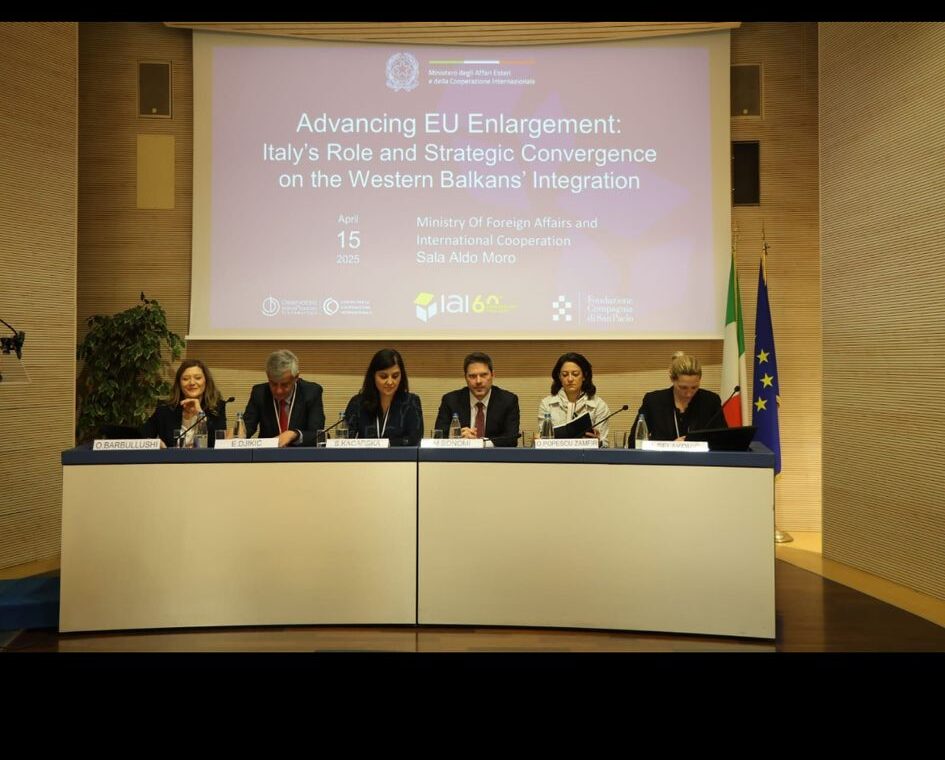
Bojana Selaković, Coordinator of the National Convention on the European Union (NCEU), participated in a high-level conference held on April 15 in Rome. The event was organized by the Istituto Affari Internazionali (IAI) and Osservatorio Balcani e Caucaso Transeuropa, in partnership with the Italian Ministry of Foreign Affairs and International Cooperation and with the support of the Compagnia di San Paolo Foundation. The conference was dedicated to discussing the future prospects of EU enlargement, with a particular focus on the Western Balkans.
This gathering provided a significant platform for exchanging views on recent developments, current trends, and the strategic implications of the enlargement process, all within the context of shifting geopolitical dynamics and the EU’s continued commitment to the European integration of the region.
The program featured two thematic panels addressing key aspects of the enlargement process. The first panel, which included remarks from NCEU Coordinator Bojana Selaković, focused on progress in implementing reforms, the level of regional cooperation, and the strategic objectives of the Western Balkan countries. Special attention was given to the EU’s Growth Plan for the Western Balkans, aimed at granting earlier access to specific segments of the EU single market prior to full membership.
In her address, Selaković highlighted the challenges that civil society has faced throughout the integration process, especially during the drafting of the Reform Agenda. “Although formal mechanisms for participation exist, in practice, the influence of non-state actors on reforms has been virtually non-existent. This has brought us to a point where citizens are taking to the streets demanding from the institutions what should have already been delivered as part of the EU accession process,” she stated.
She also emphasized the need for European actors to reach a common understanding on the purpose and nature of the European Union as a political project, questioning whether it is primarily a community of interests, a defensive alliance, or a union based on shared values. “Once we have those answers, we’ll also understand the true purpose of the enlargement policy,” Selaković concluded.
The second panel, titled “What Kind of Enlargement Is the EU Pursuing?”, explored the Union’s own readiness for further expansion and its strategic priorities. The discussion particularly focused on how the enlargement process can be structured to maintain momentum, deliver tangible benefits to candidate countries, and strengthen institutional cohesion within the EU as it prepares for future enlargement.